Start a Clothing Brand: 6 Steps, 3 Ways to Produce
Concept, logo, business setup, trademark, production, sales: the 6 steps to start a clothing brand, from print on demand to factory runs.
By Gaël Pons
Published , updated
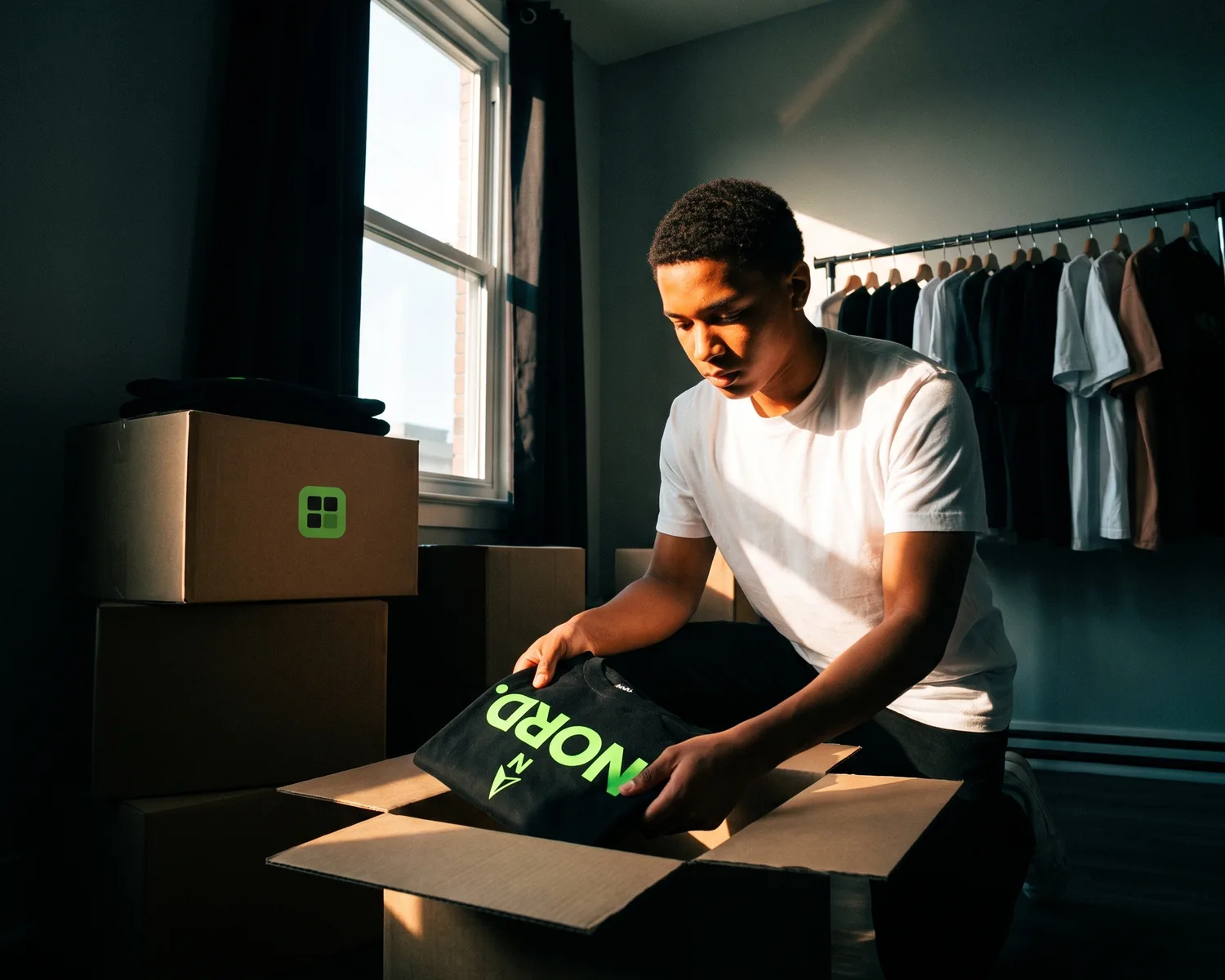
To start a clothing brand, you go through six steps: pick a concept and an audience, get your logo into a vector file, set up the business, protect the name, produce, then sell. Production is where the money goes: print on demand, small batches, or a factory run.
What are the steps to start a clothing brand?
Starting a clothing brand takes six steps, in this order: concept, logo, business setup, trademark, production and sales. Here they are at a glance, each one explained further down.
- Concept and audience: who the brand is for, and why they would wear it over anything else on the rack.
- Logo: the mark that gets embroidered or printed on every piece, prepared as a vector file from day one.
- Business setup: the legal structure you sell under.
- Trademark: protecting the brand name.
- Production: print on demand, small batch, or a manufacturer.
- Sales: online store, social media, pop-up markets, pre-orders.
Where do you begin with a clothing brand?
A clothing brand begins with a specific group of people, not with fabric or equipment. Brands that take off early sell a sense of belonging: a neighborhood, a sport, a team, a music scene, an inside joke. Before you sketch anything, write one sentence about who buys the very first shirt and where you already run into them. If the answer is “everyone”, keep narrowing.
What kind of logo does a clothing brand need?
A clothing brand needs a simple logo that still reads when small and that exists as a vector file: outlines and flat color instead of tiny colored squares, so it scales to any size. On a garment, a left-chest logo is only a few inches wide: thin gradients and tiny lettering vanish, especially in thread.
Plan three versions from the start: full color, a single-color version and a white version for dark garments. Why white wins on a black hoodie is explained in white logos for dark backgrounds, and every setting to check before production sits in our print-ready logo checklist.
Who owns your brand’s logo?
You own your brand’s logo only if you designed it yourself or if the designer signed the rights over to you in writing. Under US law, a freelance designer keeps the copyright in the artwork until a written, signed transfer says otherwise (17 U.S.C. § 204). So ask whoever made it for two things: that signed transfer, and the logo’s source files. A logo lifted from the internet, or generated from someone else’s work, can’t serve as your brand.
Which business structure suits a new clothing brand?
For a solo clothing brand on a small budget, a sole proprietorship is the simplest structure: you can start selling under your own name and file business income with your personal taxes. An LLC is the usual next step, because it separates your personal assets from the business; it costs a state filing fee and some paperwork. Outside the US, the logic is the same: the lightest status first, a company once you have partners or real revenue.
Should you trademark your clothing brand name?
You don’t need a trademark to sell clothes, but registering one is what stops someone else from using your name. In the US, you file with the USPTO, paying a fee per class of goods; clothing sits in class 25, bags and leather goods in class 18. Before paying, search the USPTO database: if a similar name already exists in class 25, rename now, while nothing is printed yet.
How do you produce your first clothes?
You can produce your first clothes in three ways: print on demand, small batches ordered from a decorator, or a manufacturer. They differ in minimum order, the cash you put up front, and the margin you keep.
| Print on demand | Small batch | Manufacturer | |
|---|---|---|---|
| Minimum order | 1 piece | About a dozen pieces | Often several hundred per style |
| Cash up front | None | Moderate | High |
| Cost per piece | Highest | Middle | Lowest |
| Decoration | Mostly printing | Embroidery, screen printing, transfers, printing | Everything, plus custom cuts and woven labels |
| Best for | Testing an idea | First collection, a drop, a team | A brand that knows its volumes |
| Examples | Printful, Printify, Spreadshirt | Local print shops and embroiderers | Cut-and-sew factories |
Print on demand: test with zero inventory
With print on demand, the platform makes each piece only when a customer orders it, then ships it for you, so you buy nothing ahead of time. It’s the lowest-risk way to see whether a design sells. The trade-off: a high cost per piece, a thin margin, and a choice of blanks and decoration methods limited to the platform’s catalog.
Small batch: a real first collection
A small batch means ordering your designs already decorated, a dozen or a few dozen at a time, from a local print shop, an embroiderer or an online custom apparel service. You choose the garment and the decoration method, the cost per piece drops well below print on demand, and you don’t tie up hundreds of shirts. It fits a first drop sold to your community or a set of team gear.
Manufacturer: once you know your volumes
A cut-and-sew manufacturer opens every door: your own pattern, chosen fabric, woven labels with your name, and the lowest price per piece. In return you face minimums per style and per color, paid samples and lead times of several weeks. It’s a growth step, rarely a starting point.
Embroidery, screen printing or vinyl: which decoration should you choose?
The right decoration for a clothing brand depends on the artwork and the quantity. Embroidery gives a raised, durable finish, ideal for a small chest logo; here’s how to prepare a logo for embroidery. Screen printing a logo pays off on larger runs and big designs in few colors. Heat transfer vinyl suits short runs, names and numbers.
How do you sell your first collection?
Your first collection sells where your audience already hangs out: your Instagram or TikTok, makers’ markets, team events, local shows. Pre-orders are the safest tool: you show the designs, take payment, then order exactly what sold. To show a piece that doesn’t exist yet, try your logo on a t-shirt, hoodie, sweatshirt or tote bag in our free mockup generator, which also sends a high-resolution copy by email. An online store (Shopify, Etsy, or the storefront built into your print-on-demand platform) adds to that first circle; it doesn’t replace it.
How do you get your logo as a vector file without a designer?
If your brand’s logo only exists as a PNG or JPG, Depixelise rebuilds it as a vector file in roughly ten seconds. The whole thing is 100% free, and you won’t need an account or find a watermark. Drop in the image (any PNG, JPG, WebP or SVG file under 10 MB) and the converted logo appears full size, zoomable. What arrives by email is a set of four: the SVG, a 2000 px PNG on a transparent background, a single-color version for thread and a negative version for black or navy fabric. Those files are yours to keep: send them to a print-on-demand platform, a factory or the embroiderer down the street, and switch suppliers whenever you like. One caveat: a logo you only have as a tiny thumbnail gets scaled up automatically, and its outlines are redrawn in the process, so line up both versions letter by letter before you order a hundred hoodies. To see what’s inside that SVG, read our explainer on what an SVG file is.
FAQ
How much does it cost to start a clothing brand?
With print on demand, starting a clothing brand can cost little more than a few samples, plus a trademark filing if you protect the name. A small batch adds the price of a first order; a factory run means thousands of dollars in inventory.
Do you need a designer to create a clothing brand logo?
You don’t need a designer, though one helps for a logo meant to last for years. If you draw it yourself, keep the shapes simple, test it at about two inches wide, and turn it into a vector file before your first order.
Can you use a free font in a clothing brand logo?
Yes, as long as the font’s license allows commercial use and trademark use. Check the license on the foundry’s site: most Google Fonts, for instance, are under open licenses that allow use in a logo.
Do you need labels to sell clothing?
In the US, clothing sold to the public needs a label with fiber content, country of origin and the maker or seller’s identity, under the FTC’s textile labeling rules. A woven label with your name is a branding choice, often replaced at first by a print inside the neck.
Can you sell clothes with a team or city logo?
Only with written permission from the owner: a team crest, a city seal or an event logo belongs to whoever holds it. Pitch an official collection to the team instead, and they’ll give you both the file and the green light.