Logo Embroidery: Colors, Minimum Size and the File to Send
Getting a logo ready for embroidery: how many thread colors, the smallest text that works, the file your embroiderer needs, and what digitizing is.
By Gaël Pons
Published , updated
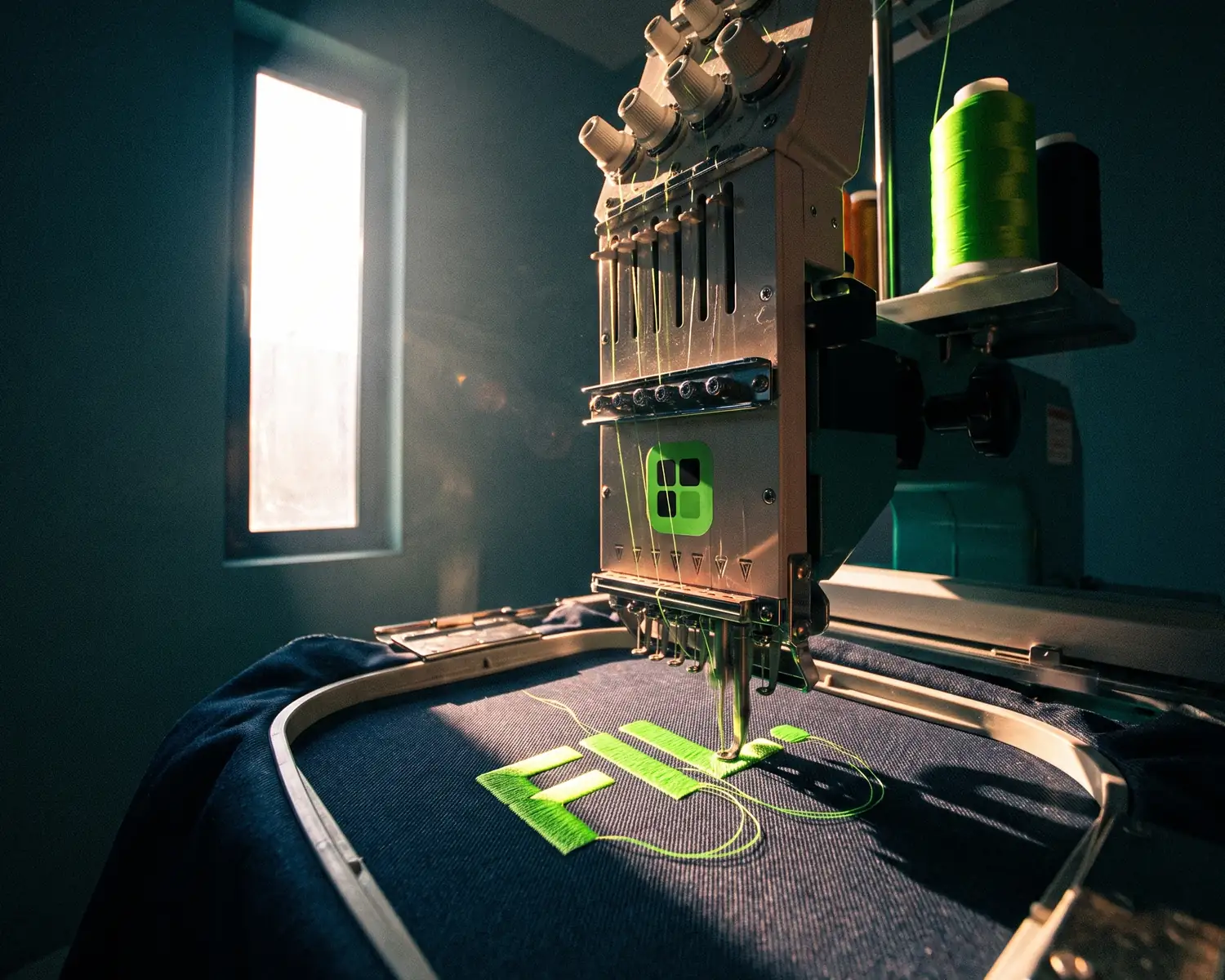
An embroidery-ready logo uses a few solid colors, has no detail thinner than a needle can sew, and reaches your embroiderer as a vector file. The shop then turns that file into a stitch program for its machine, a step called digitizing.
How do you prepare a logo for embroidery?
Preparing a logo for embroidery comes down to three moves: cut the colors down to a handful of clear shades, enlarge or drop anything too thin, and hand over a vector file, which stores clean outlines your embroiderer can follow rather than a mosaic of pixels. The reason is physical: an embroidery machine lays down thread one stitch at a time, while a printer sprays ink.
Before you ask for a quote:
- remove drop shadows, glows and textures, which thread can’t reproduce;
- swap every gradient for a flat color;
- check that your smallest line of text is still readable at the real stitched size;
- track down the largest original file you have, not a thumbnail from social media.
Why does an embroiderer ask for a vector file?
An embroiderer asks for a vector file because the digitizing software follows the outline of each shape to plan where the needle goes. A JPG or PNG has no outlines, only a grid of pixels, so the software can’t tell where a letter starts or where the background ends.
SVG, vector PDF, EPS and AI all work: they’re different containers for the same shapes. For a side-by-side look at each one, see what a vector file is.
How many thread colors can an embroidered logo have?
An embroidered logo works best with few colors, because each shade is a separate spool of thread and a thread change on the machine. More colors mean more stitching time and a higher price, with no visible benefit past a handful of shades.
Close shades cause a second problem: two blues that look different on screen often end up on the same spool. If your brand has exact color references, pass them on so the shop can pick the nearest threads from its chart; that’s precisely what Pantone colors for a logo are for. To list your logo’s colors and see how many it has, drop it into the image color picker.
What is the minimum text size for embroidery?
Embroidered text stays readable when letters are at least about a quarter inch tall, the minimum Hatch Embroidery’s lettering size guide gives for simple fonts like Verdana or Times New Roman. Below that, stitches run into each other, the holes inside letters fill up and the word turns into a blob of thread.
A left-chest logo is small, so do the math at its real size: a tagline that fits on a poster rarely fits on a chest logo, and dropping it beats shrinking it. Very thin lines follow the same rule, since a hairline vanishes between two stitches.
To check this before ordering, place your logo on the left chest of a sweatshirt in the free mockup generator and see if the smallest words still read. The preview shows placement and contrast, not the texture of the thread.
What is embroidery digitizing?
Embroidery digitizing is the conversion of your vector file into a stitch program: the sewing order, the direction of the thread, the density of each area. The output is a machine file (DST, PES or JEF depending on the machine brand) that holds no picture at all, just sewing instructions.
It’s skilled work, usually charged once per logo and reused on every later order, so ask whether the quote includes it. The cleaner your vector file, the faster and cheaper that step tends to go.
Can a logo be embroidered in one color?
A logo can absolutely be embroidered in a single color: that’s tone-on-tone embroidery (navy thread on a navy polo, white thread on a black hoodie), understated and often cheaper. Your embroiderer starts from a single-color version where the whole design sits on one shade.
Watch out for logos with two similar colors: flattened onto one thread, lettering placed on a colored shape can merge with it and disappear. Look at the one-color version before you approve, and ask the shop to add a small gap between elements if needed.
Embroidery or print: which suits a logo better?
Embroidery suits a simple logo on a garment you’ll keep a long time (team wear, uniforms, a brand piece): it has texture, doesn’t crack and survives the wash. Printing stays the better choice for a big graphic, a photo or lots of colors. The garment often decides, as the custom embroidered t-shirt guide shows. If you want to stitch a photo rather than a logo, that’s a different process, covered in photo to embroidery.
Four files for your embroidery order, from one upload
Only have your logo as a JPG or PNG? Upload it to Depixelise, which redraws it as clean shapes in about ten seconds, with no sign-up and no watermark, 100% free. The background is removed, and you can zoom in on the result, full size on screen. Four files, sent by email, cover the whole order: the SVG your embroiderer digitizes; a transparent-background PNG, 2000 px wide, for the mockup or the order form, a single-color version ready for one-thread embroidery, and a light negative version to preview the logo on dark fabric. A very small source image is upscaled first and its shapes rebuilt, so compare each letter with your original. Depixelise doesn’t embroider anything; it gets the file ready.
Where can you get your logo embroidered?
You can have your logo embroidered by a local shop or order online, on almost any garment or accessory. Each one comes with its own limits, covered in our guides to custom embroidered hats and custom embroidered patches. Whoever you choose, send the same vector file and ask to see a stitched sample before the full run.
FAQ
Can a logo be embroidered from a plain JPG?
Yes, but the JPG has to be turned into shapes first, either by you or by the shop. Some embroiderers do it themselves and add it to the quote; showing up with a vector file removes that line and the back-and-forth.
Can a logo with a gradient be embroidered?
Not as it is: thread can’t blend smoothly from one shade to another. The gradient becomes two or three bands of color, or a single flat color, which often looks cleaner anyway.
Will the embroiderer change my logo?
Often, yes: while digitizing, they may thicken a line, widen a letter or drop a detail that wouldn’t hold. Ask for a preview of the stitch program, or better a stitched sample, to approve those tweaks.
Can I open a DST file on my computer?
Not with everyday software: a DST or PES file opens in embroidery software. Keep your vector file too, since it’s the one you’ll need for printing, your website or another shop.
Does 3D puff embroidery need a different logo?
Yes. 3D puff embroidery stitches over a foam layer, so it needs bold, filled shapes and no small text. A clean, simple logo works well; save a detailed one for flat embroidery.